

 UBO · White-label card platform
Your cards, your brand, our platform
Hover over or tap a decision to read its explanation.
to decide
Median of an authorization in UBO, checks, rules, reservation and recording included.
every decision
The step, the rule and its version, the data read: a decision can be read, replayed and exported.
for every operation
Network, file, API or portal: the same processing, the same entries, the same events.
every bank
Several banks on one platform, separated by the database itself, with their quotas.
The platform
Between your cardholders, the networks and your bank
UBO plays the issuer: it receives the card networks' requests, decides, clears, handles disputes, keeps the accounting and has the cards made. Your bank keeps the customer relationship and its brand, and steers everything from its portal, its API, its files and its events.
The life of a payment
From a payment to the accounting, seamlessly
What happens in UBO between the moment a cardholder presents their card and the day's accounting close.
- 1T + 0
The payment
The cardholder pays; the network sends the authorization request to UBO's station.
Network stations - 2≈ 50 ms
The authorization
Card, authentication, the bank's rules, balance and limits: UBO answers and records its decision.
Authorization engine - 3A few seconds
The event
Signed webhook and Kafka message to the bank's systems, to notify the customer.
Events - 4D + 1
The clearing
The network's file arrives over SFTP; the presentment debits the cardholder and releases the hold.
Clearing - 5Every night
The accounting
Double-entry postings, checks, day close and report to the bank.
Accounting - 6If disputed
The dispute
A case with its evidence, its PSD2 and network deadlines, its four-eyes decisions.
Disputes
The whole lifecycle
A component for every card business
Each component is complete, set by the bank, available through the portal and the API.
Issuing
Products, designs, chip profiles, cardholders, accounts and cards, physical or virtual.
- Versioned products, BIN, channels, countries
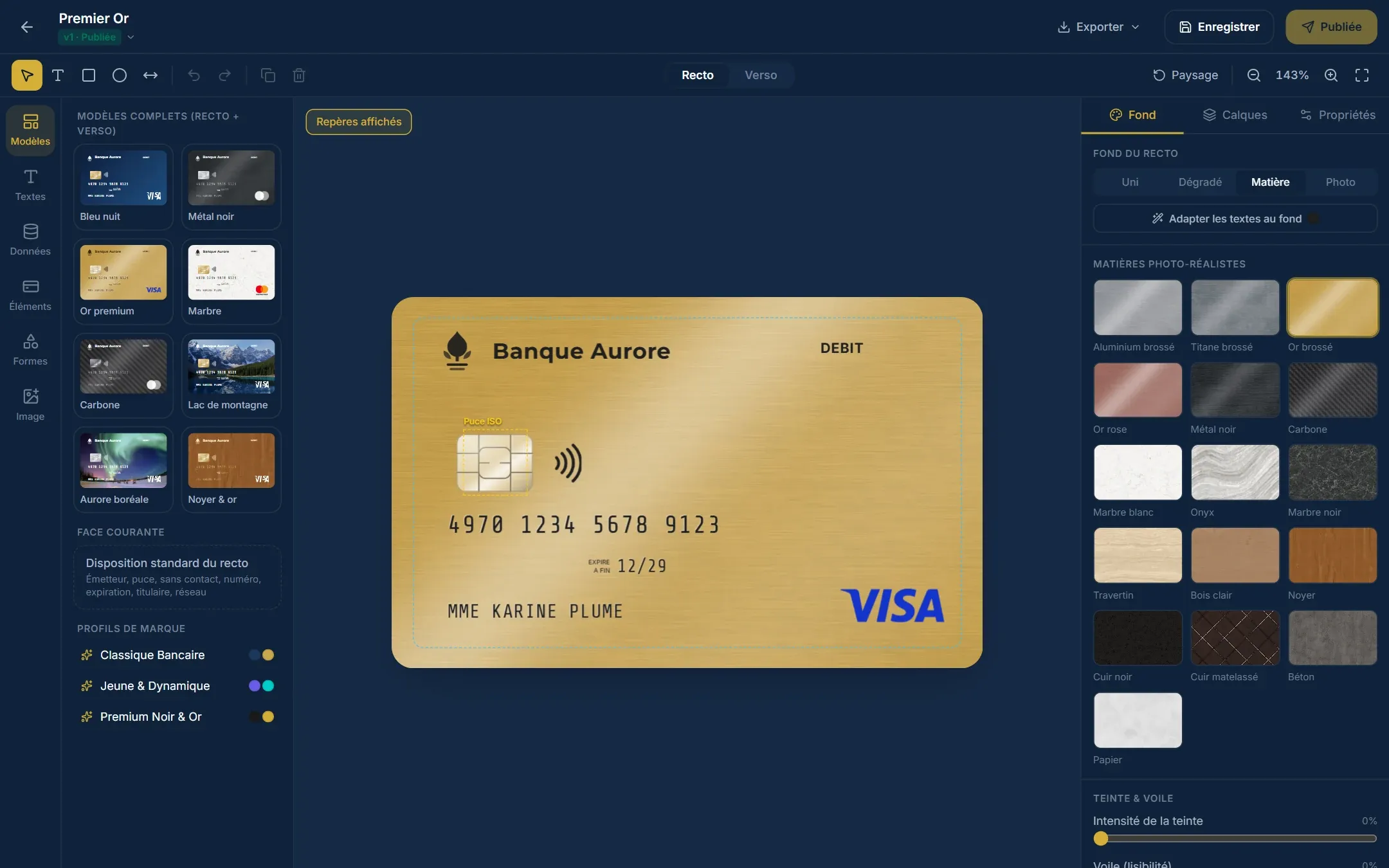
- Card design studio
- Declared card lifecycle
Authorization
Each request decided in a few tens of milliseconds, and explained.
- PIN, CVV, cryptograms by the HSM
- 3-D Secure and PSD2 exemptions
- Pre-authorizations, cash-back, stand-in
Rules
The bank's policy as versioned rules, tested on the history before activation.
- Conditions on all the data
- External calls with timeouts, circuit breaker
- Replay as it was or with today's rules
Clearing
The networks' files checked, integrated line by line and matched.
- Totals, duplicates, encryption checked
- Matching and offline operations
- Same effects as the API, idempotent
Disputes
Complete cases, from the cardholder's first contact to arbitration.
- Encrypted, versioned evidence
- Network and PSD2 deadlines, escalations
- Four-eyes financial decisions
Accounting
Every movement becomes entries, per the bank's scheme.
- Transactional financial events
- Controlled close every night
- Signed report for the bank
Manufacturing
Physical cards routed to the personalisers, and tracked.
- Weighted routing, fallback, capacities
- Batches encrypted for the personaliser
- Tracking until delivery
Security
Keys in the HSM, secrets in the vault, sensitive data under control.
- Card numbers encrypted, never returned
- Display in clear justified and approved
- Banks isolated by the database
Steering
Real-time activity, reporting and platform monitoring.
- Dashboard and reporting
- Audit trail, end-to-end flows
- Quotas and consumption per bank
For developers
A payment in three calls
A REST API described in OpenAPI, secured with OAuth 2.0, with the same effects as the network: the same decision, the same entries, the same events.
- Create the cardholderIn an organisation of the bank:
POST /cardholders. - Issue their cardPhysical or virtual, on a product of the bank; the number stays in the vault:
POST /cards. - Authorize a paymentThe authorization engine decides and explains its decision:
POST /authorize.
● 00 Approved in 31 ms · €42.50 held
AUTH="Authorization: Bearer $TOKEN"; JSON="content-type: application/json"# 1. The cardholdercurl -s $UBO/cardholders -H "$AUTH" -H "$JSON" \ -d '{"entity_id":"'$ENTITY'","first_name":"Camille","last_name":"Durand","email":"camille.durand@example.com"}'# 2. Their virtual card (account opened, card activated next)curl -s $UBO/cards -H "$AUTH" -H "$JSON" \ -d '{"entity_id":"'$ENTITY'","cardholder_id":"'$HOLDER'","product_code":"VISA-CLQ-PART","form_factor":"VIRTUAL","account_id":"'$ACCOUNT'"}'# 3. A paymentcurl -s $UBO/authorize -H "$AUTH" -H "$JSON" \ -d '{"card_id":"'$CARD'","amount":4250,"currency":"EUR","mcc":"5411","merchant_name":"Leclerc","merchant_country":"FR"}'import requests
ubo = requests.Session()ubo.headers["Authorization"] = f"Bearer {token}"API = "http://localhost:3000"
# 1. The cardholderholder = ubo.post(f"{API}/cardholders", json={"entity_id": entity, "first_name": "Camille", "last_name": "Durand", "email": "camille.durand@example.com"}).json()# 2. Their virtual card (account opened, card activated next)card = ubo.post(f"{API}/cards", json={"entity_id": entity, "cardholder_id": holder["id"], "product_code": "VISA-CLQ-PART", "form_factor": "VIRTUAL", "account_id": account}).json()# 3. A paymentauth = ubo.post(f"{API}/authorize", json={"card_id": card["id"], "amount": 4250, "currency": "EUR", "mcc": "5411", "merchant_name": "Leclerc", "merchant_country": "FR"}).json()print(auth["response_code"], auth["pipeline_duration_ms"], "ms") # 00 31 msvar http = HttpClient.newHttpClient();Function<String, HttpRequest.Builder> api = path -> HttpRequest .newBuilder(URI.create("http://localhost:3000" + path)) .header("Authorization", "Bearer " + token) .header("Content-Type", "application/json");
// 1. The cardholdervar holder = http.send(api.apply("/cardholders").POST(ofString(""" {"entity_id": "%s", "first_name": "Camille", "last_name": "Durand", "email": "camille.durand@example.com"}""".formatted(entity))).build(), BodyHandlers.ofString());// 2. Their virtual card (account opened, card activated next)var card = http.send(api.apply("/cards").POST(ofString(""" {"entity_id": "%s", "cardholder_id": "%s", "product_code": "VISA-CLQ-PART", "form_factor": "VIRTUAL", "account_id": "%s"}""".formatted(entity, holderId, account))).build(), BodyHandlers.ofString());// 3. A paymentvar auth = http.send(api.apply("/authorize").POST(ofString(""" {"card_id": "%s", "amount": 4250, "currency": "EUR", "mcc": "5411", "merchant_name": "Leclerc", "merchant_country": "FR"}""".formatted(cardId))).build(), BodyHandlers.ofString());The portal
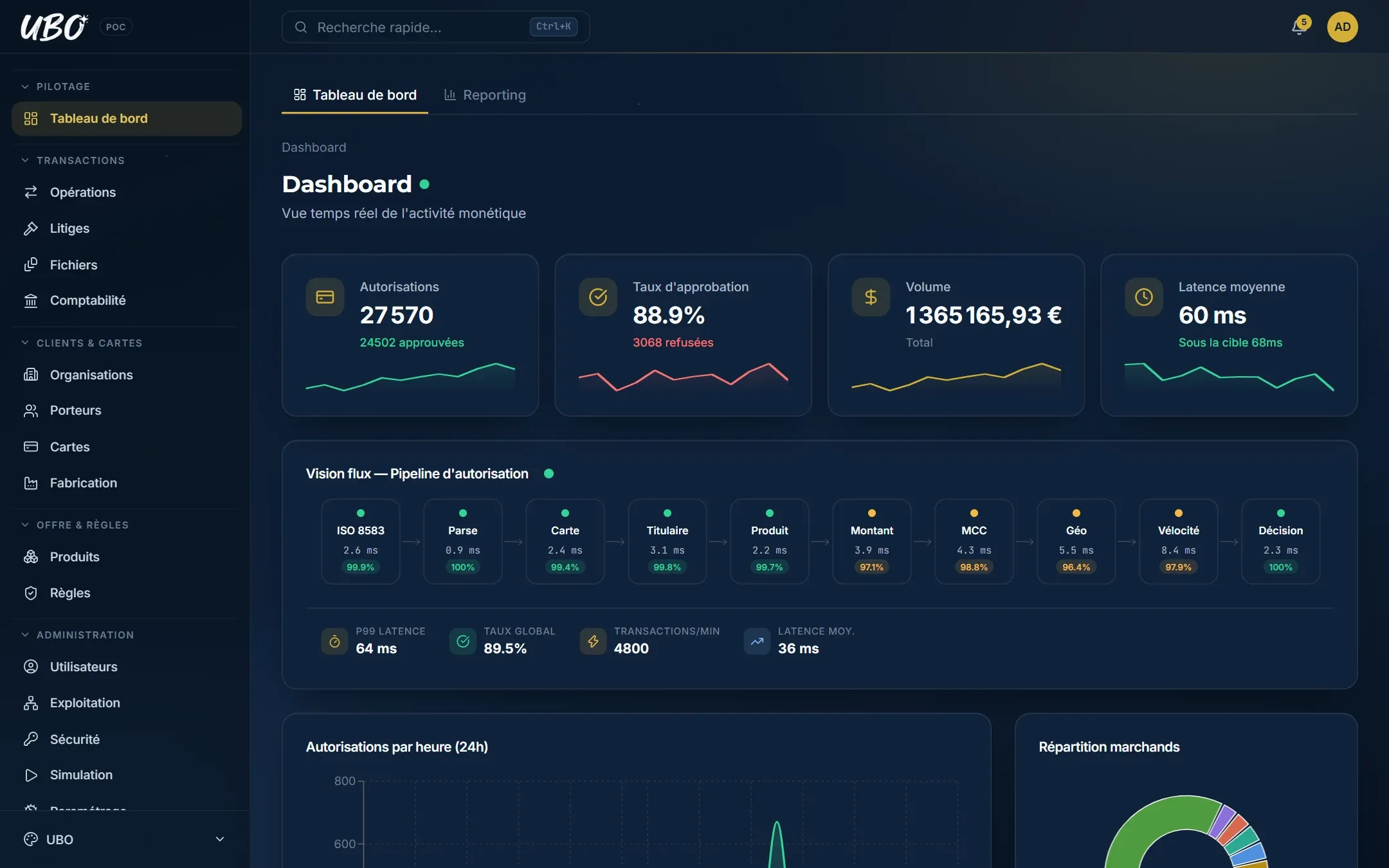
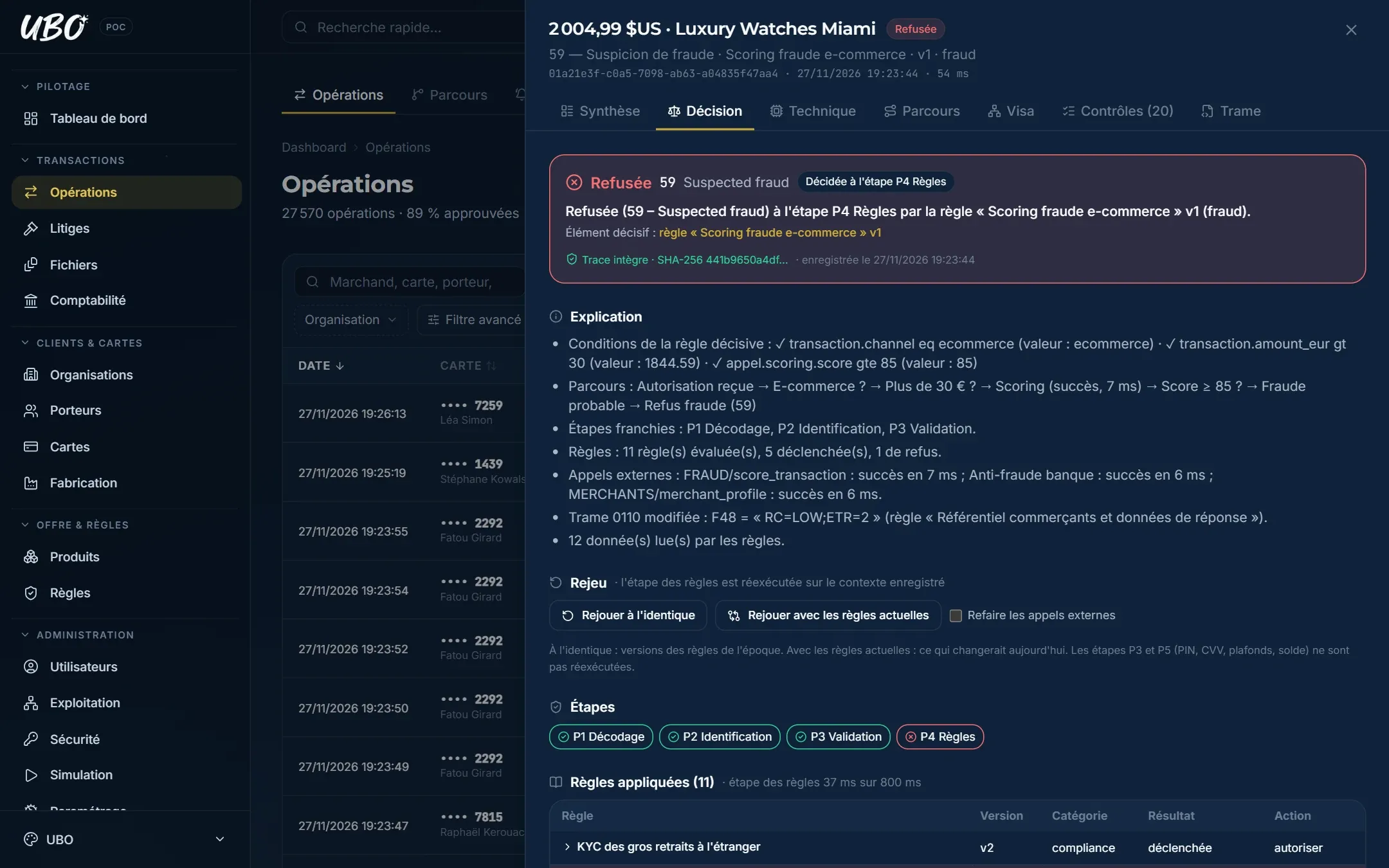
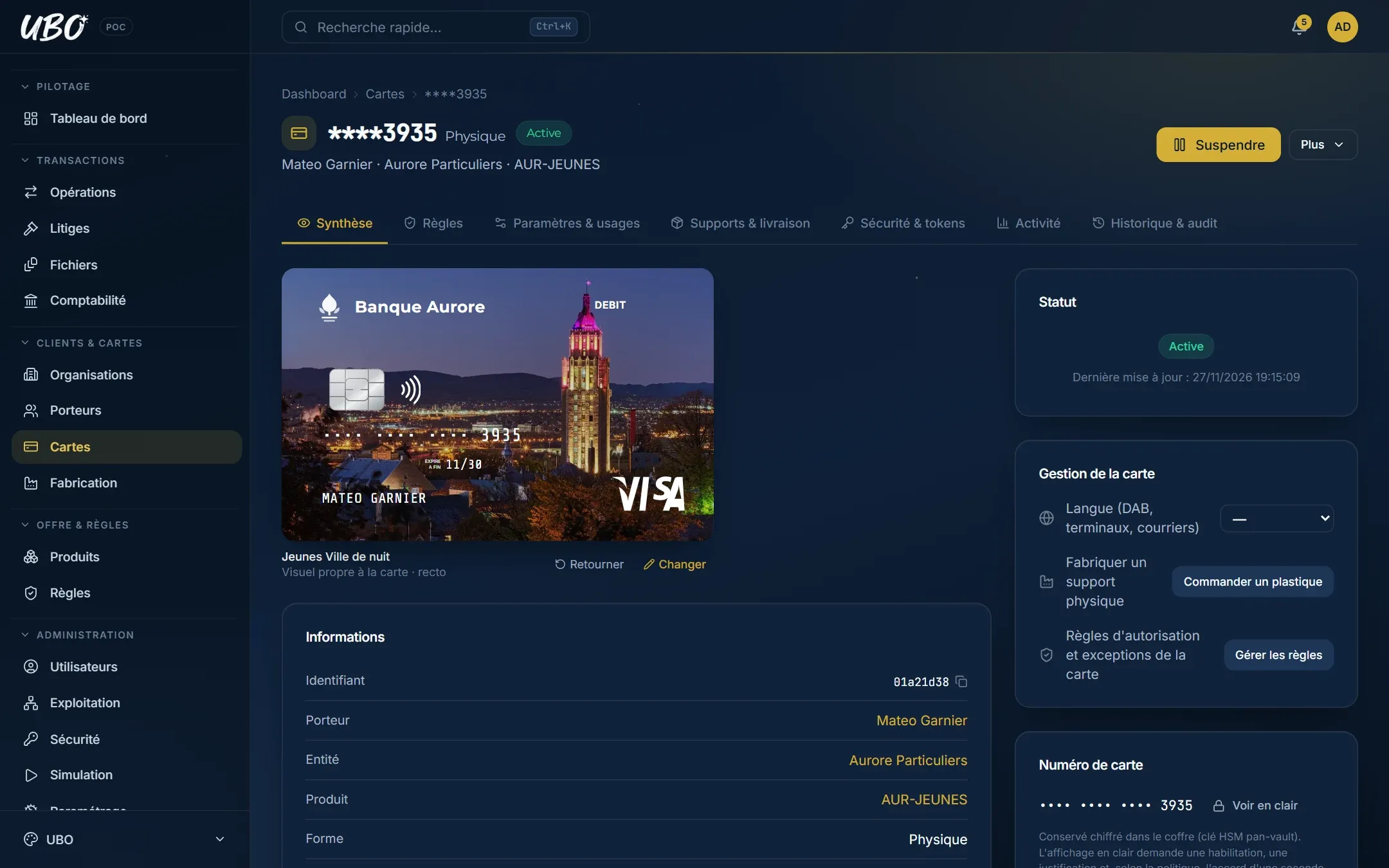
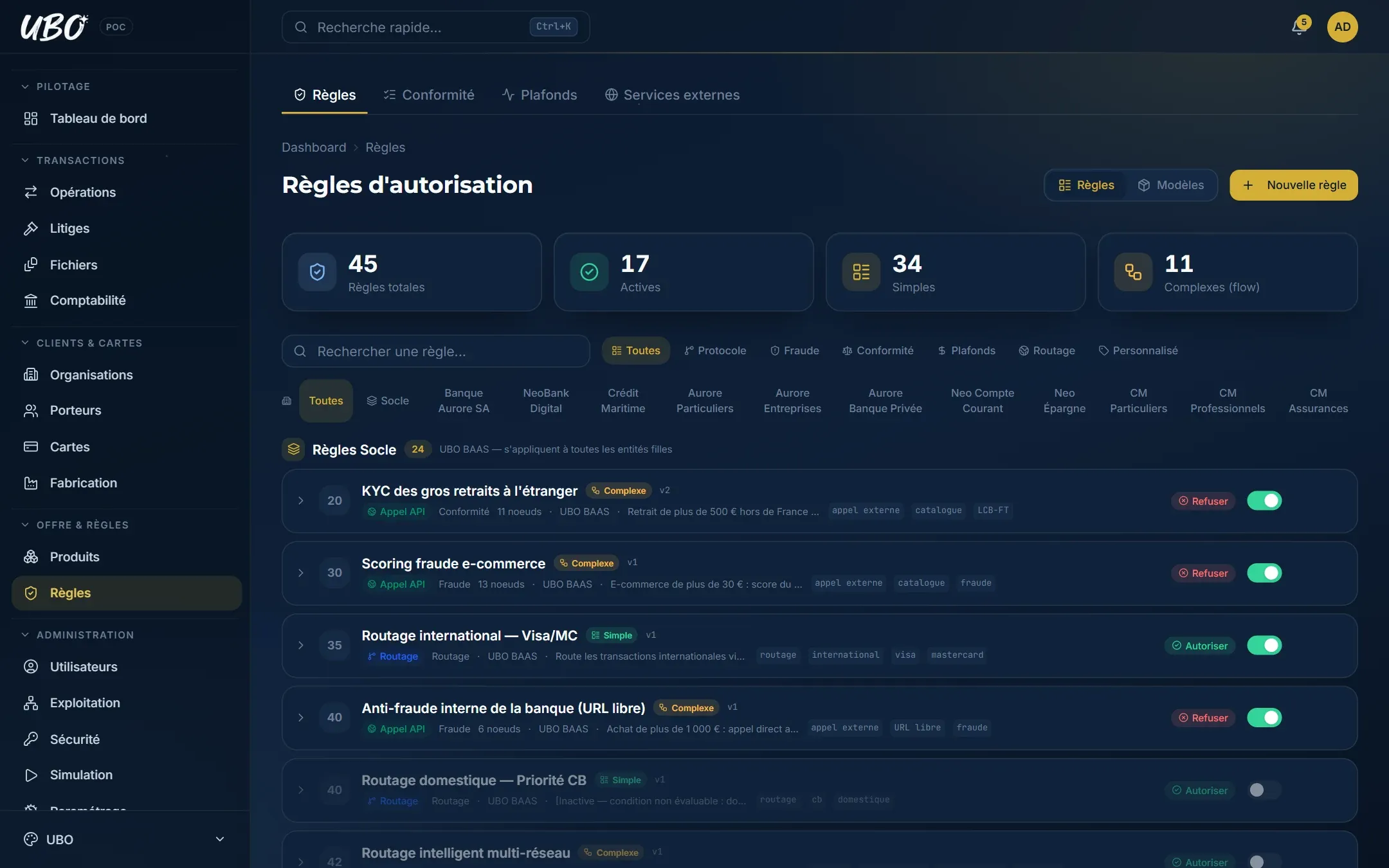
A portal for every team of the bank
Customer service, business, fraud, back office, accounting, operations: each with its screens and rights, on the same data. The portal's interface is in French.
Where to start
Documentation for everyone
Discover the offer
What UBO does, for whom, with which guarantees.
Use the portal
Each screen, step by step, and how each component works.
Integrate the API
A first payment in ten minutes, then the whole reference.
Run the platform
Architecture, flows, availability, security, monitoring.
What's new
Just arrived
Two gateways and a replica
Failover with no failed call, browsing and reporting on a read replica, journals partitioned by month.
Multi-bankBanks isolated by the database
A second demo bank, a platform administrator whose accesses are visible, quotas per bank.
DocumentationThis site, in French and English
Full-page API reference with live calls, business components, architecture as flows, UBO brand guide.
Week of 23 November 2026All the release notes →
Frequently asked questions
What banks ask us
Will our cardholders see the UBO brand?
No. The cards, the designs, the messages to cardholders and the portal carry the bank's brand. UBO appears nowhere to your customers.
Does UBO replace our core banking system?
No. UBO keeps the card accounts and their movements, and reports to your system through its files (authorization journal, daily accounting report), its events and its API. The customer relationship, credit decisions and the brand stay with you.
Are our data separate from the other banks'?
Yes, by the database itself: each query only sees the rows of the bank making it, even if the code forgot to filter. A test checks every API route with two banks.
Which card networks?
Visa and Mastercard: real ISO 8583 messages over TCP stations, each dialect described as data. Visa's BASE II clearing is complete (EBCDIC, PGP, matching).
How do our systems exchange with UBO?
Through the REST API (OpenAPI 3.1, OAuth 2.0), the events (signed webhooks and Kafka) and the files (SFTP, signed and encrypted). See Architecture.
Where does the platform stand?
UBO is a proof of concept that runs today in containers: two gateways behind Traefik, PostgreSQL and its replica, Kafka, Redis, a secrets vault and a simulated HSM. See the release notes.
Launch a card on UBO
A first cardholder, their virtual card and their first payment, through the API, in ten minutes on the development platform.