

Accounting
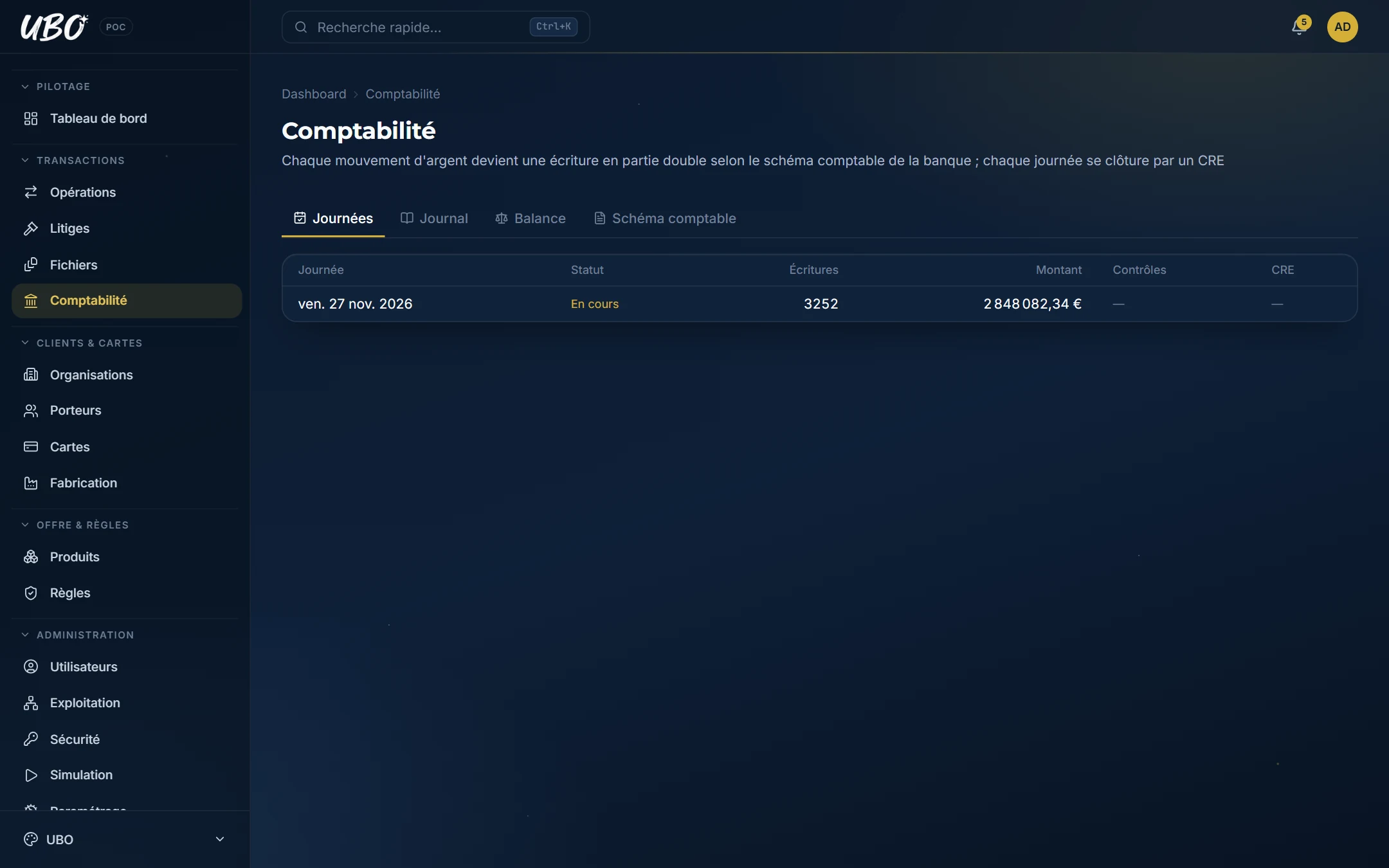
Transactions → Comptabilité. Each money movement becomes a double-entry posting per the bank’s accounting scheme; each day closes into an accounting report (CRE, compte rendu d’événements), the file the bank’s accounting receives.
From an operation to the report
Section titled “From an operation to the report”- An operation changes the cardholder’s money: presentment, withdrawal, refund, reversal, dispute decision, fee. In the same transaction, UBO records a financial event (type, amount, currency, direction, accounting day, value date, origin).
- The rules of the bank’s accounting scheme give, for each event type, the account debited, the account credited and the label.
- The entries are produced: debit equals credit, always.
- At the closing of the day (every night, or by hand), the totals are frozen and the report is produced, signed and made available to the bank.
| Event | Debit | Credit |
|---|---|---|
| Purchase cleared | Cardholder accounts | Network settlement payable |
| Withdrawal cleared | Cardholder accounts | Network settlement payable |
| Refund cleared | Network settlement payable | Cardholder accounts |
| Dispute provisional credit | Disputes in progress | Cardholder accounts |
| Operation without a cardholder account | Suspense | Network settlement payable |
Default scheme, simplified: each bank has its own.
The tabs
Section titled “The tabs”| Tab | Content |
|---|---|
| Journées (days) | Each accounting day: status (open, closed), number of entries, amount, checks, report |
| Journal | The entries, filtered by account, event type, operation |
| Balance | The balance of each account of the bank’s chart |
| Schéma comptable | The chart of accounts and the rules, versioned: a published version no longer changes |
How it works
Section titled “How it works”How it works in detail, beyond the screens: