

Authorization rules
Rules apply at step P4 of each authorization, after the card checks and before the amount is reserved. They express the bank’s policy: fraud, compliance, routing, restrictions specific to a brand or a clientele.
The rule list
Section titled “The rule list”Offre & règles → Règles.
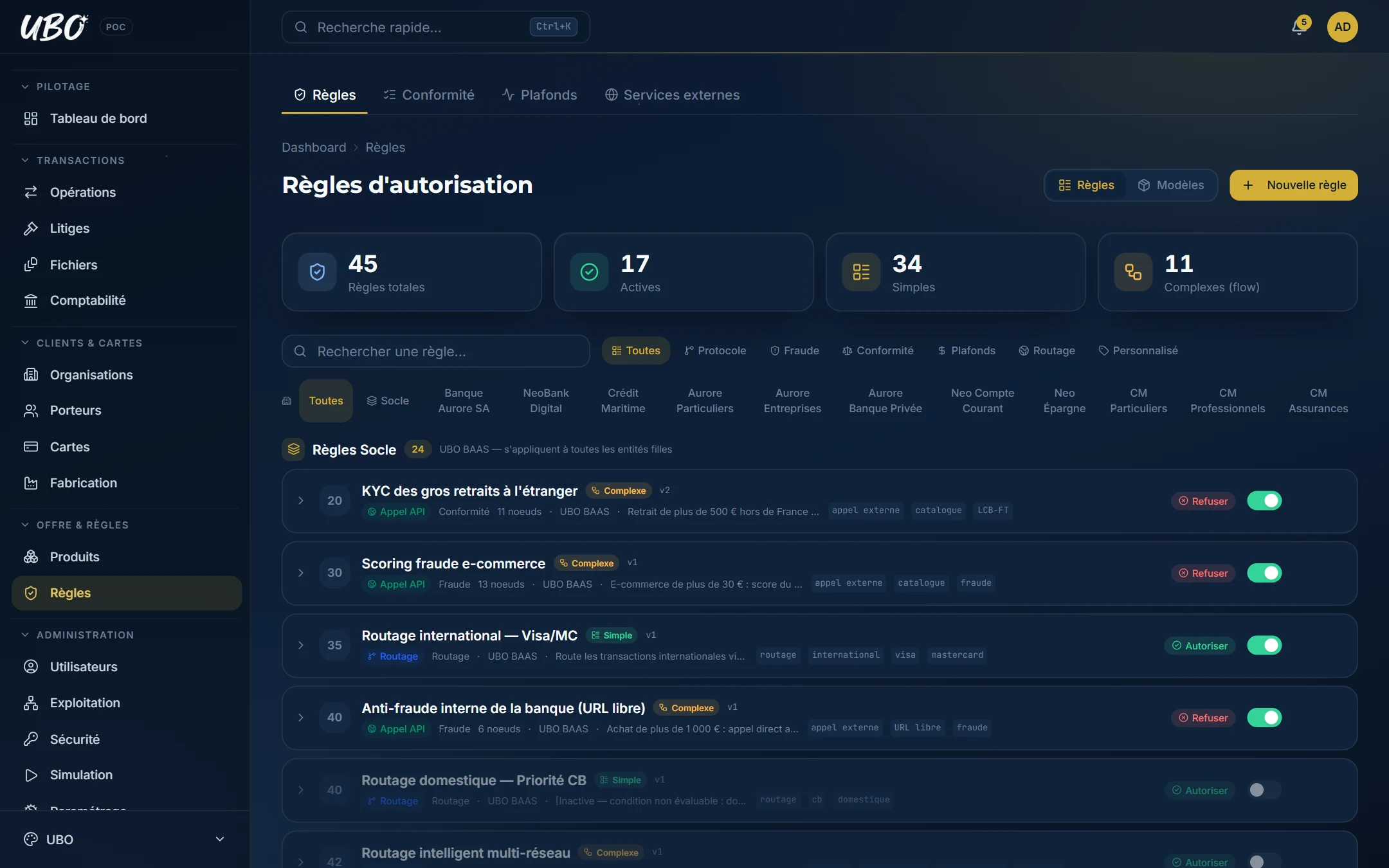
- Categories: protocol, fraud, compliance, limits, routing, custom.
- Scope: “socle” (base) rules apply to all the bank’s organisations; the others to an organisation, a product, or a card (inclusions and exclusions on the card page).
- Priority: rules are evaluated by priority; the first that declines decides.
- Simple or complex: a simple rule is a list of conditions; a complex rule is a flow of nodes (conditions, external calls, enrichments, decisions).
- Version: each change creates a version; past decisions keep the version that made them.
- The switch activates or deactivates the rule at once.
What a rule can read
Section titled “What a rule can read”All the data of the request (amount, currency, channel, MCC, country, merchant, entry mode, 3-D Secure), of the card (product, status, age), of the cardholder (KYC, risk, PEP), of their history (count and amount of operations over 1 hour, 24 hours, 7 and 30 days, known merchant, unusual country) and the answers of the external services.
What a rule can do
Section titled “What a rule can do”| Node | Effect |
|---|---|
| Condition | Tests a data: equal, different, greater, in a list, contains… |
| External call | Queries a catalogue service (or an address) within a time limit, with retries; three outputs: success, timeout, error |
| Enrich | Computes a variable (formula on the data) for the rest of the flow |
| Change the message | Adds or changes fields of the response to the network |
| Notify | Raises an alert without blocking the operation |
| Decision | Approve; decline with a code (05, 51, 57, 59, 61, 62, 91…); flag; ask for strong authentication (1A); approve partially |
Writing and activating a rule
Section titled “Writing and activating a rule”- Nouvelle règle (new rule), or start from a template (Modèles button): KYC of large withdrawals, e-commerce scoring, routing, internal anti-fraud…
- Choose the category, the scope (socle, organisation, product) and the priority.
- Build the conditions, or the flow in the visual editor.
- Tester (test): replay the rule on past operations to see which it would have declined; enter services’ answers to test each output.
- Activate it. In the decision explorer, Impact des règles actuelles measures the effect on real decisions.
External services
Section titled “External services”Offre & règles → Règles → Services externes. The catalogue of the services the rules can call (KYC and lists, fraud score, merchant reference data) and their indicators: calls, successes, errors, timeouts, response time, state of the circuit breaker.
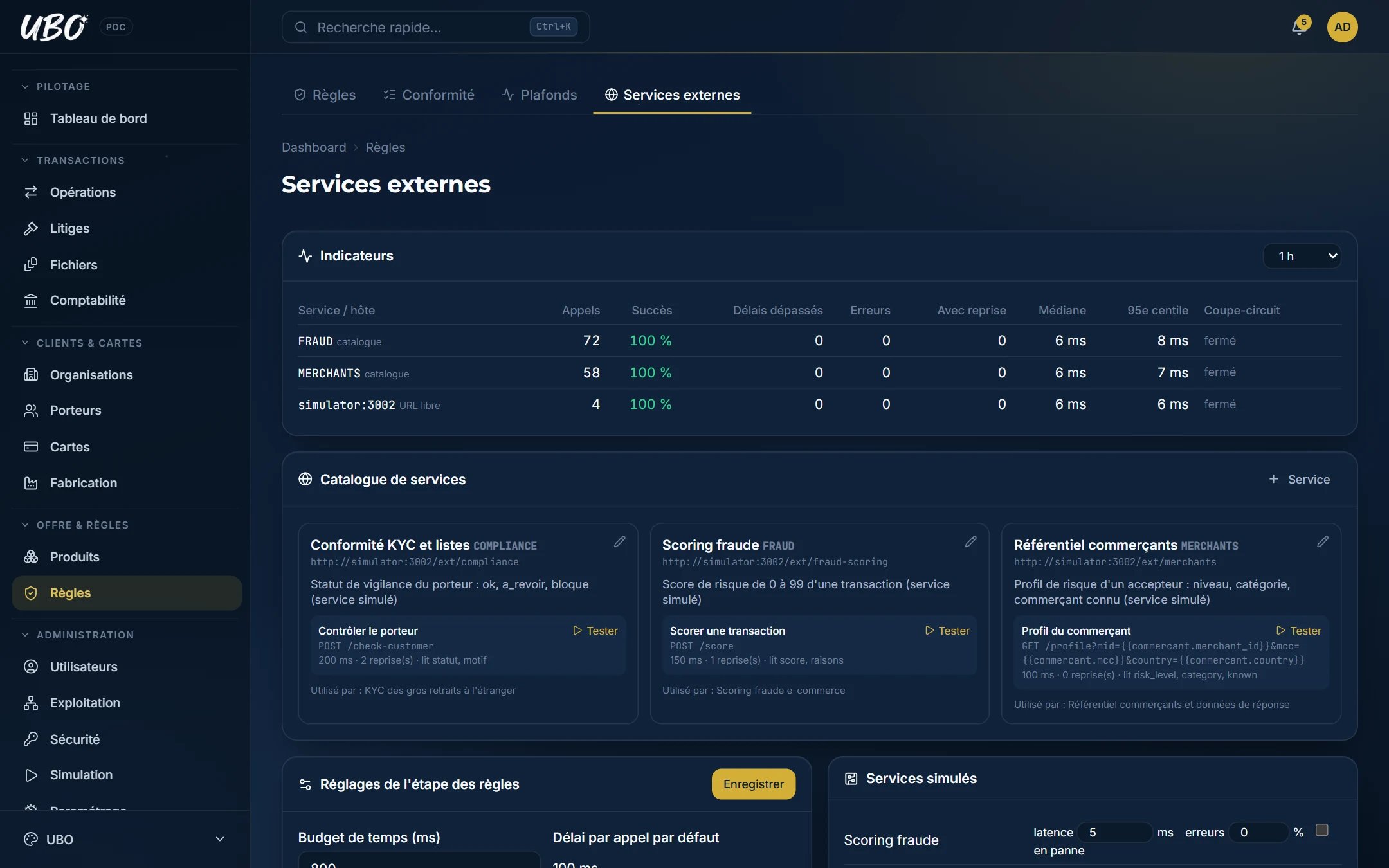
- Total time of the rules step: 800 ms by default, adjustable; beyond it, the remaining calls take the “timeout” output.
- Circuit breaker: after several failures within a minute, a service is set aside for a few seconds; its calls take the “error” output straight away.
- The services’ API keys are in the secrets vault.
Compliance
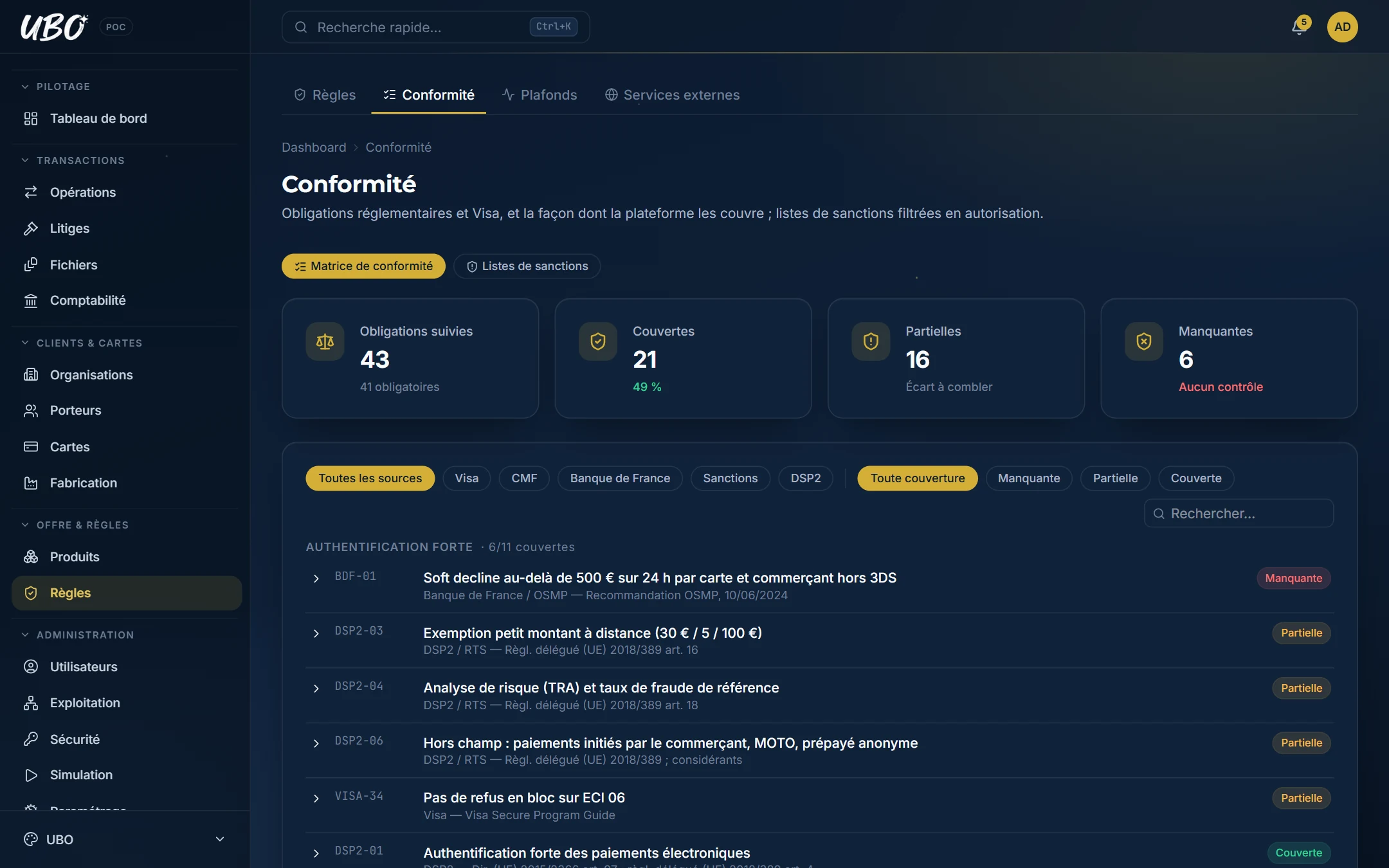
Section titled “Compliance”Offre & règles → Règles → Conformité. The matrix of obligations (PSD2 and strong authentication, AML, sanctions, network rules, Banque de France) and their coverage by the platform and the rules; the sanctions lists screened at each authorization.
How it works
Section titled “How it works”How it works in detail, beyond the screens: