
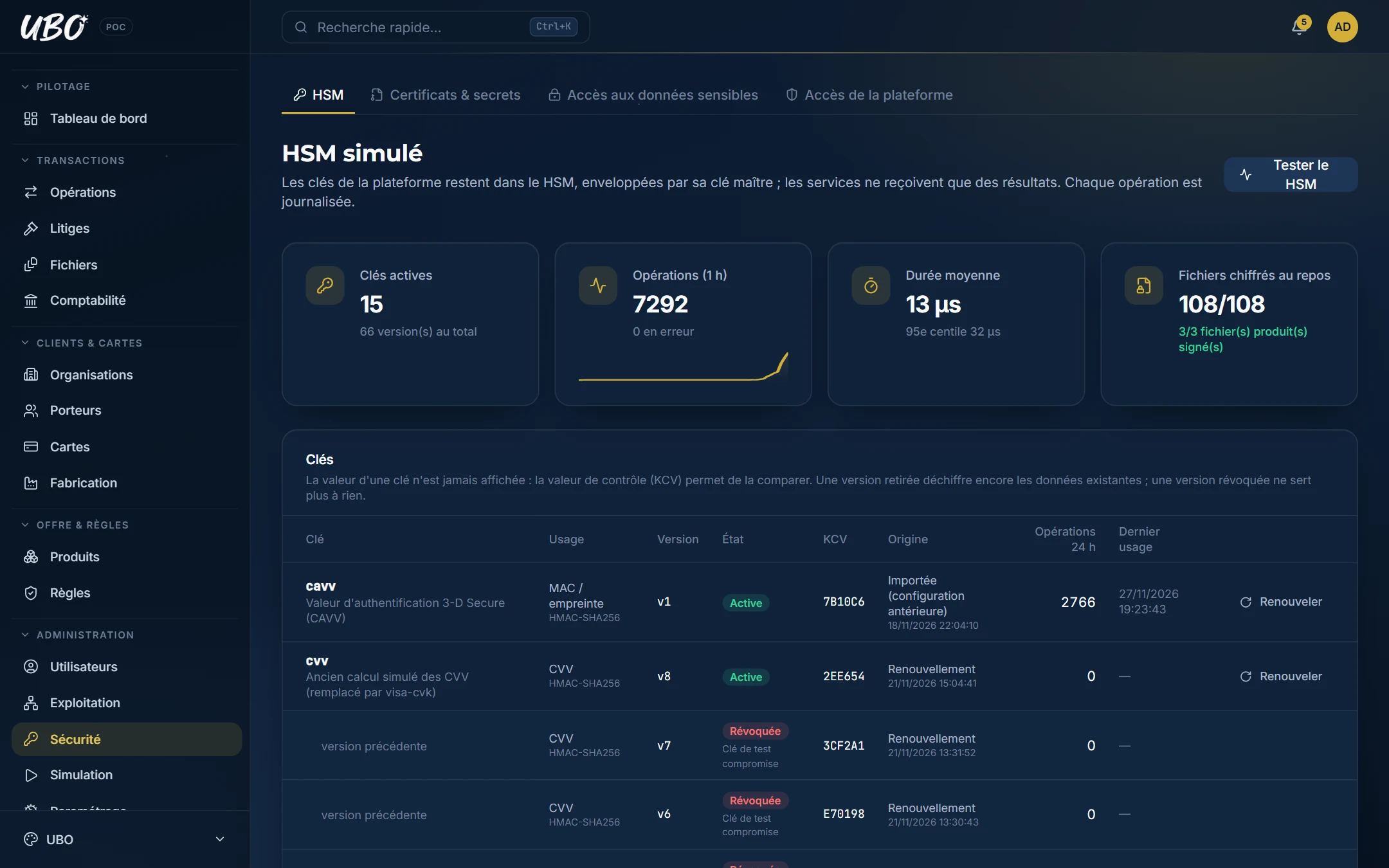
Keys do not leave
The services ask for an operation (encrypt, sign, verify a PIN, compute a CVV) and only get its result. A key is only known by its check value (KCV).
A card platform handles card numbers, PINs, network keys and the cardholders’ money. UBO is built so that no sensitive data can be read without a reason, so that a bank never sees another bank’s data, and so that every action has an author.
Keys do not leave
The services ask for an operation (encrypt, sign, verify a PIN, compute a CVV) and only get its result. A key is only known by its check value (KCV).
Banks are isolated
Isolation is enforced by the database itself: a query only sees the rows of the bank making it, even if the code forgot to filter.
Clear text is requested
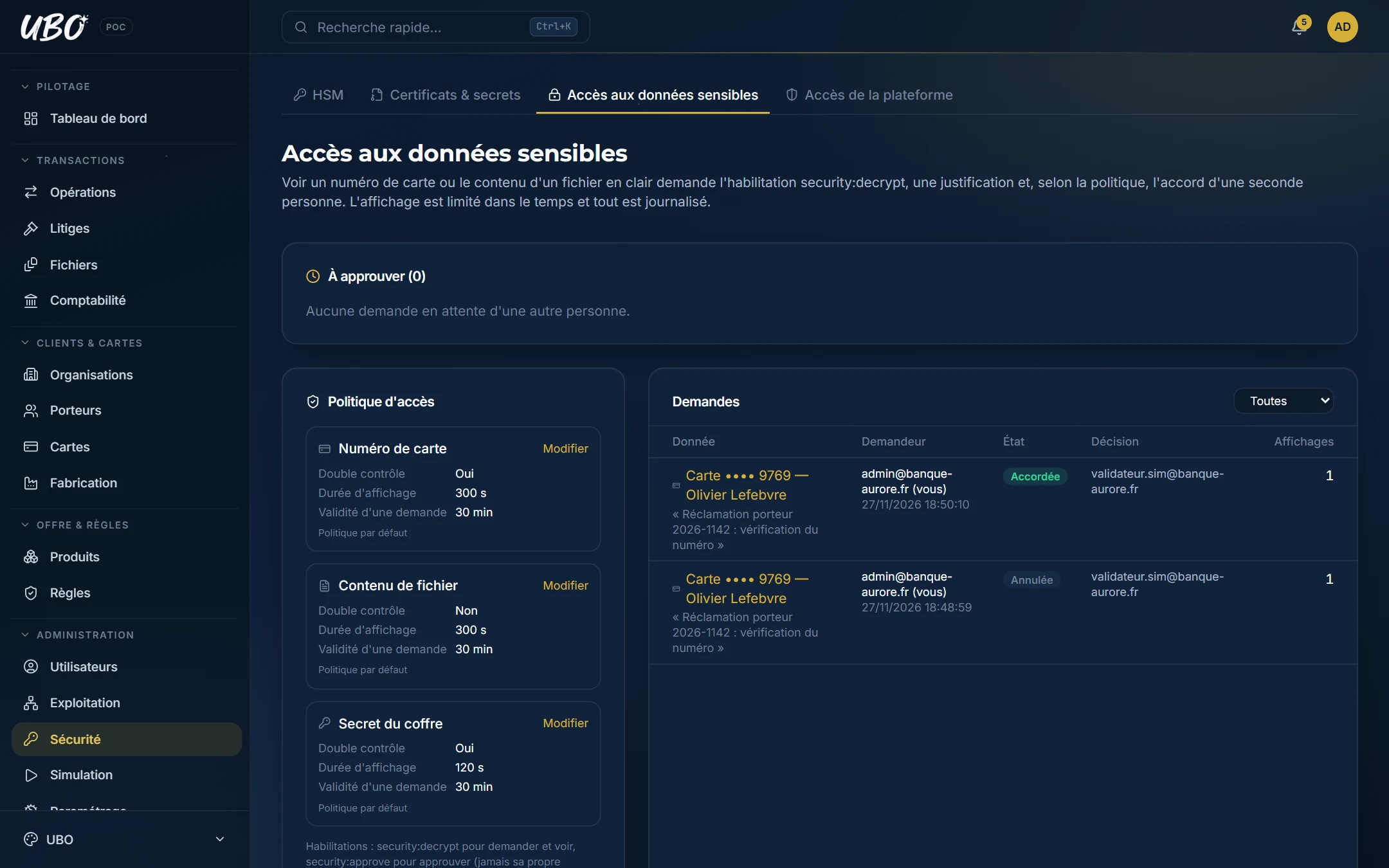
Seeing a card number or a file’s content in clear needs a permission, a justification, often another person’s approval, for a limited time.
Everything is traced
Users’ actions, HSM operations, access to sensitive data, authorization decisions (with their integrity fingerprint), the platform’s access to the banks.
| Key | Role |
|---|---|
| Card number vault | Encryption of the card numbers; a separate fingerprint finds them without decrypting. |
| Network keys (ZMK, ZPK) | Key exchange with the network, PIN block translation. |
| CVK, IMK | Verification of the CVV and of the chip cryptograms (ARQC, ARPC). |
| PIN verification | PIN verification value, 3-D Secure codes. |
| File keys | Each file is encrypted at rest with its own key, itself wrapped. |
| Signature | Each file produced is signed (Ed25519). |
Each key has a single use, versions, a rotation (the old version still decrypts, no longer encrypts) and a revocation in case of compromise. Each operation is logged.
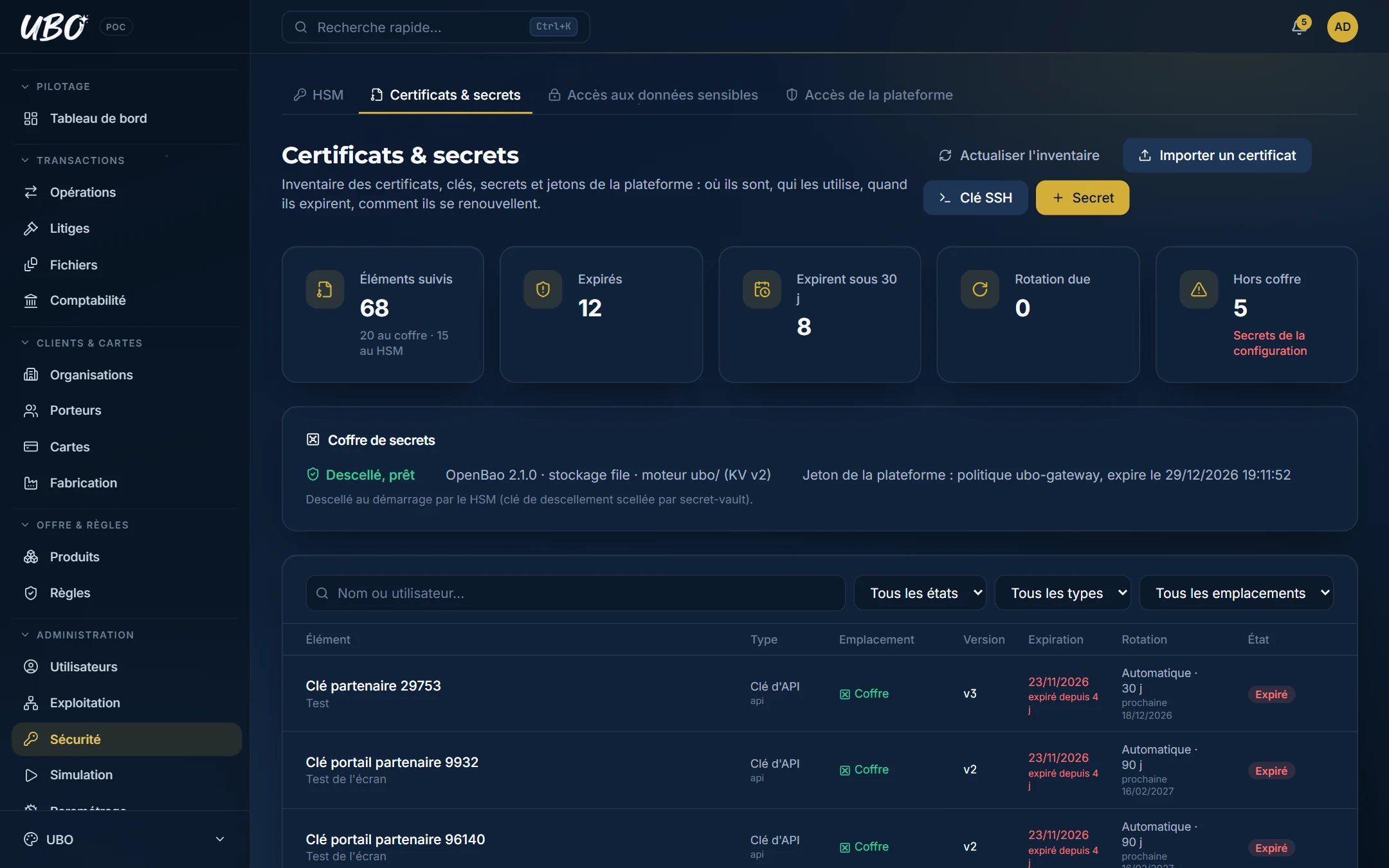
The secrets (partners’ API keys, SFTP passwords, tokens, OpenPGP keys) are in a vault (OpenBao), versioned. The inventory follows their expiry, raises alerts at 30 days, 7 days and on the day, and rotates automatically those that allow it.
The full card number or a file’s content is never shown by default. To see it:
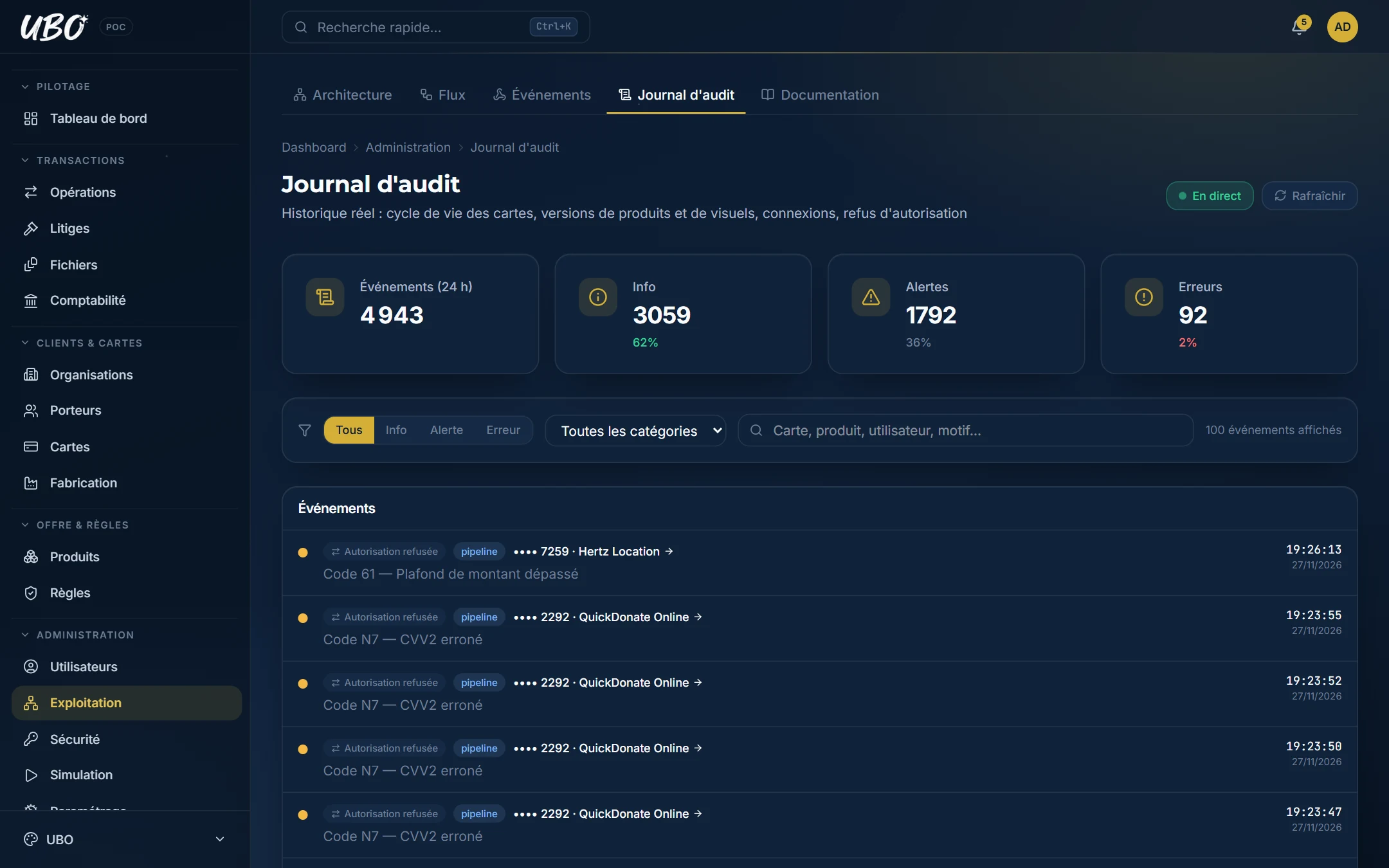
Authorization decisions carry a fingerprint (SHA-256) computed again at each read: a decision changed in the database shows as tampered. The platform administrator’s access to a bank’s data is visible to the bank itself.
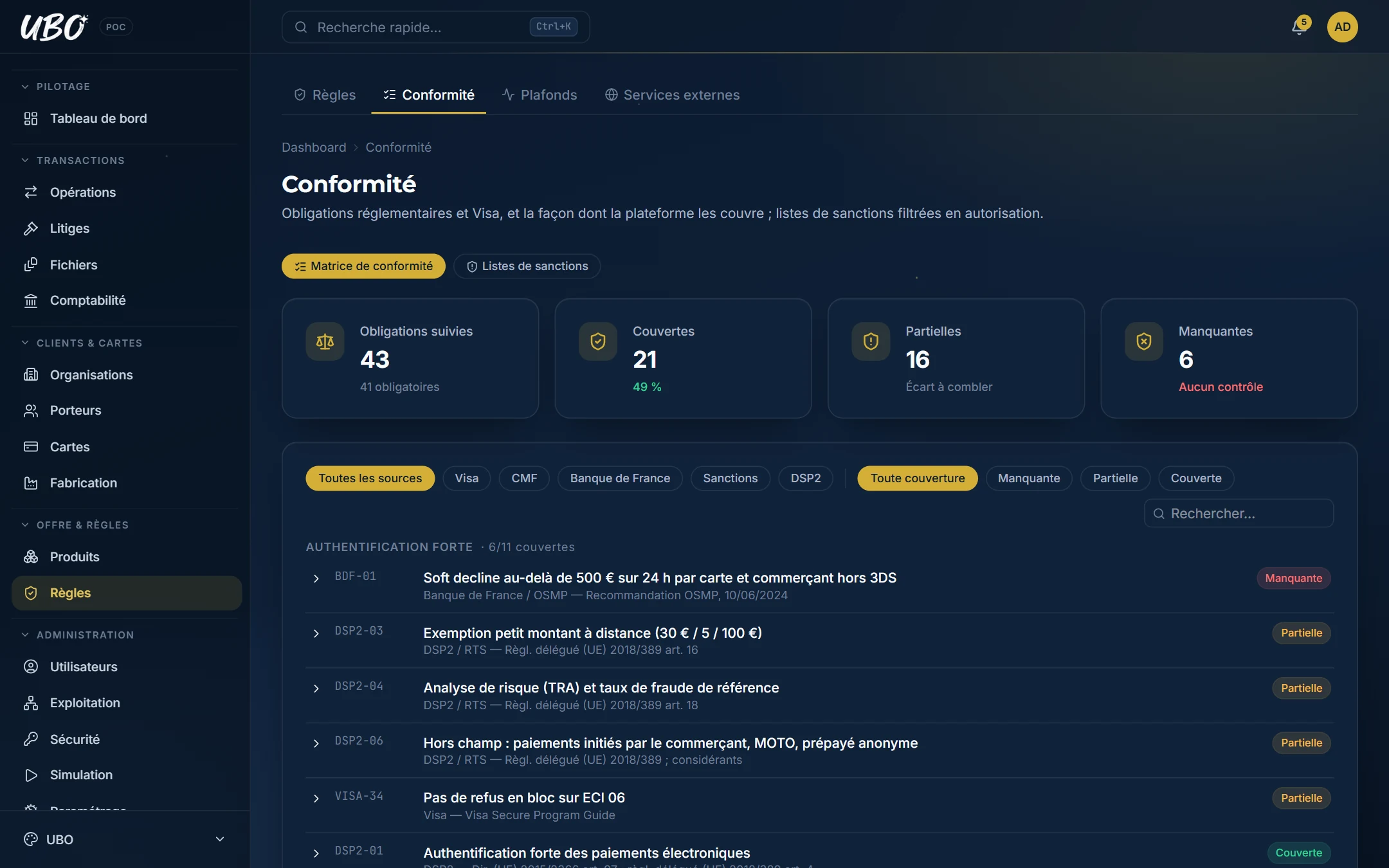
The Compliance screen follows the regulatory and network obligations (PSD2 and strong authentication, anti-money laundering and sanctions, Visa and Mastercard rules) and how the platform covers each one.