Skip to content
Portal

Features

UBO covers the whole lifecycle of a payment card. Each feature is available in the portal and through the API.

Feature What it does
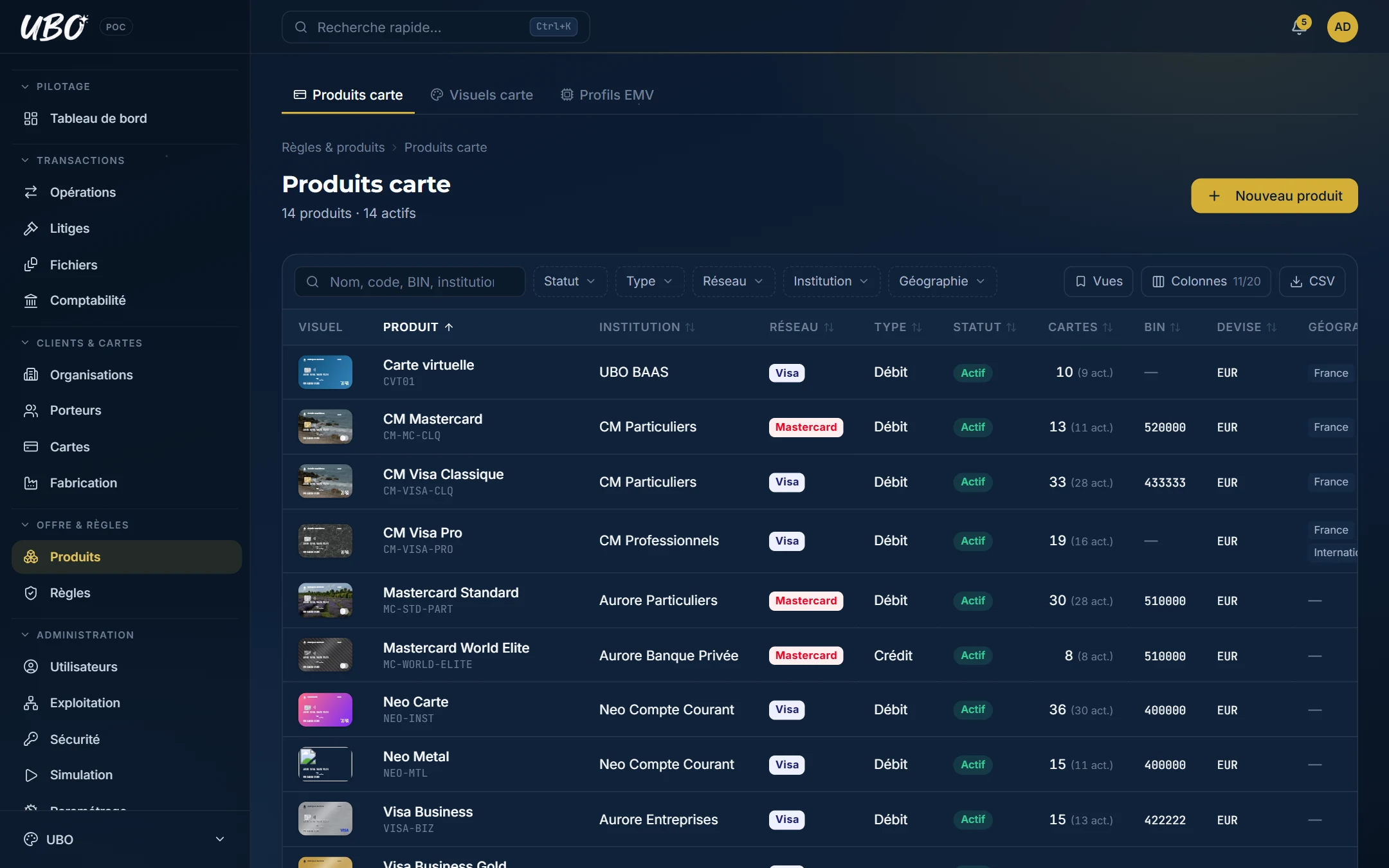
Card products The bank’s range: network (Visa, Mastercard), debit or credit, physical or virtual, currency, BIN, validity, channels and countries allowed, blocked MCCs, included services. A new product is created by copying a template.
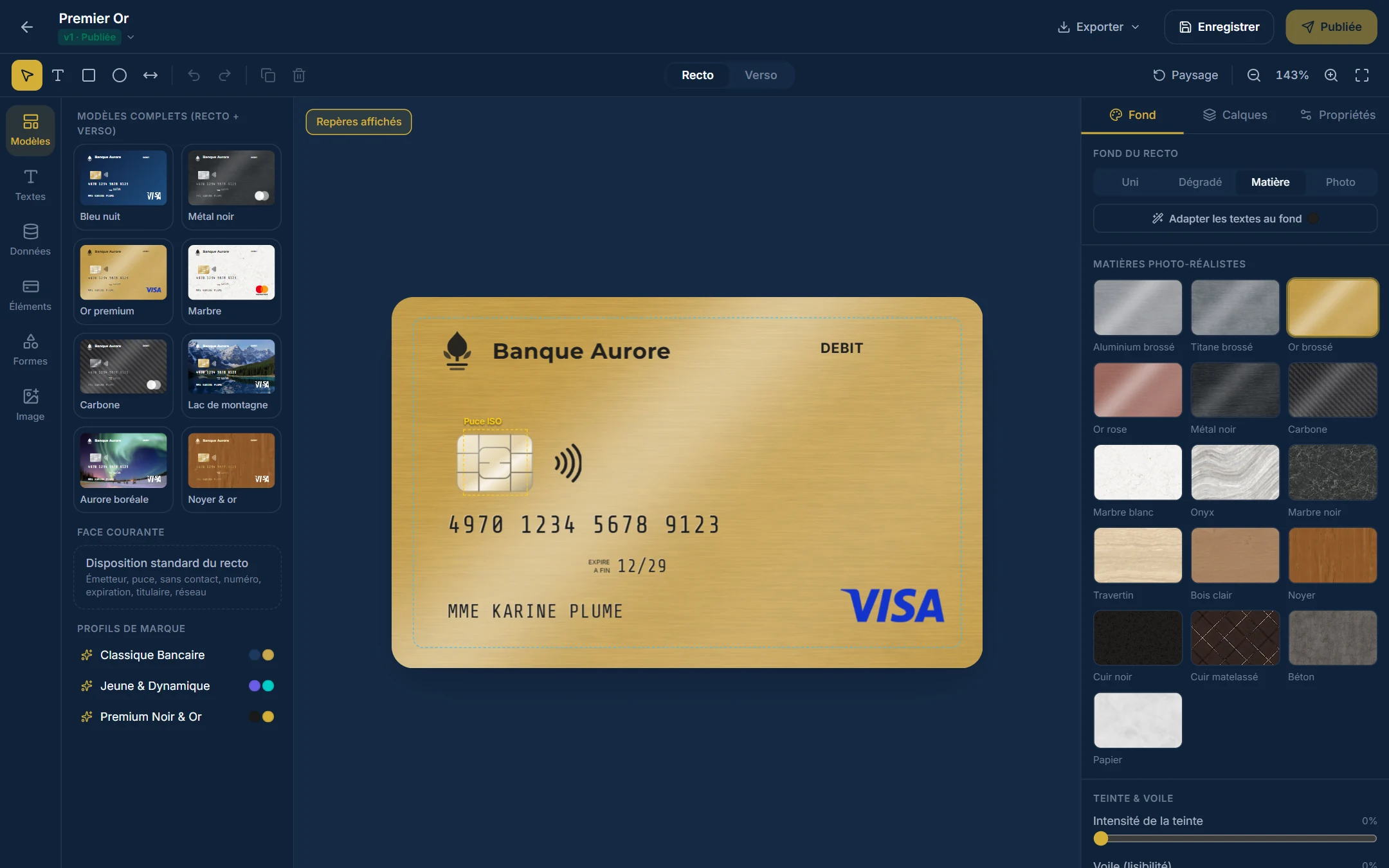
Card designs Design studio: layouts, materials (metal, wood, marble), photos, gradients, logos. Several designs per product, published after approval.
EMV profiles Chip settings: application, language, risk management, cardholder verification methods.
Limits Per product, per card, shared by several cards (a family, an account, a company), per period (day, 7 days, 30 days) and per channel.
Cardholders and accounts Identity, KYC, PEP, risk level, credited accounts and their movements. Created through the portal, the API or a file.
Cards Virtual (no manufacturing, active within seconds) or physical (manufactured), activation, blocking, temporary hold, renewal, replacement, PIN.
Card products
The range of the bank Aurore and its brands (Crédit Maritime, Neo).
Feature What it does
Authorization path Message decoding, card identification, validation (CVV, PIN, chip cryptogram, expiry date), the bank’s rules, reservation (balance, limits), response. A few tens of milliseconds.
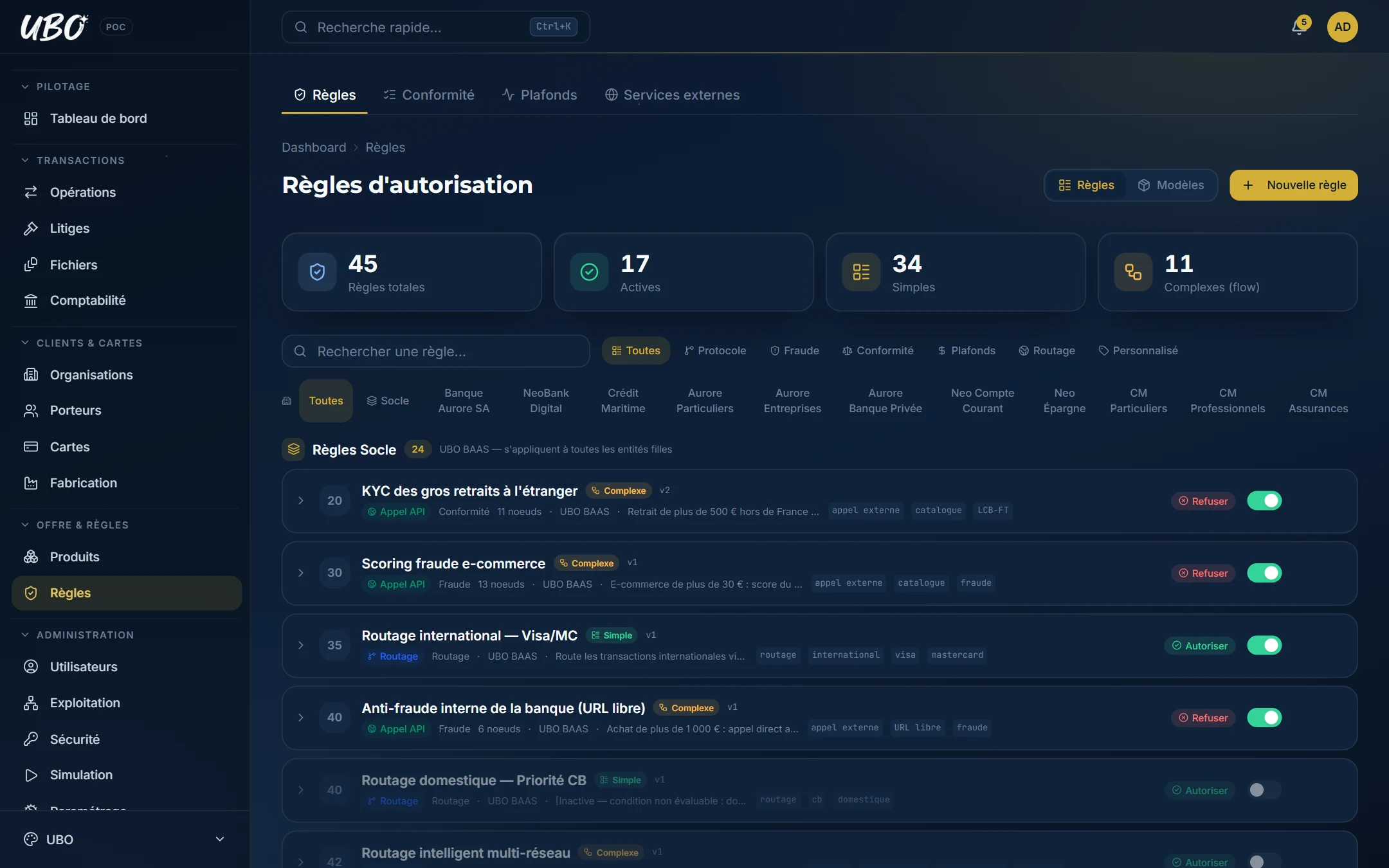
Authorization rules Conditions on all the data of the request, the card, the cardholder and their history; actions (approve, decline, flag, ask for strong authentication, change the response). Versioned, tested on the history before activation.
External calls A rule can query a service (KYC, fraud score, merchant reference data) within a time budget, with a circuit breaker and a fallback.
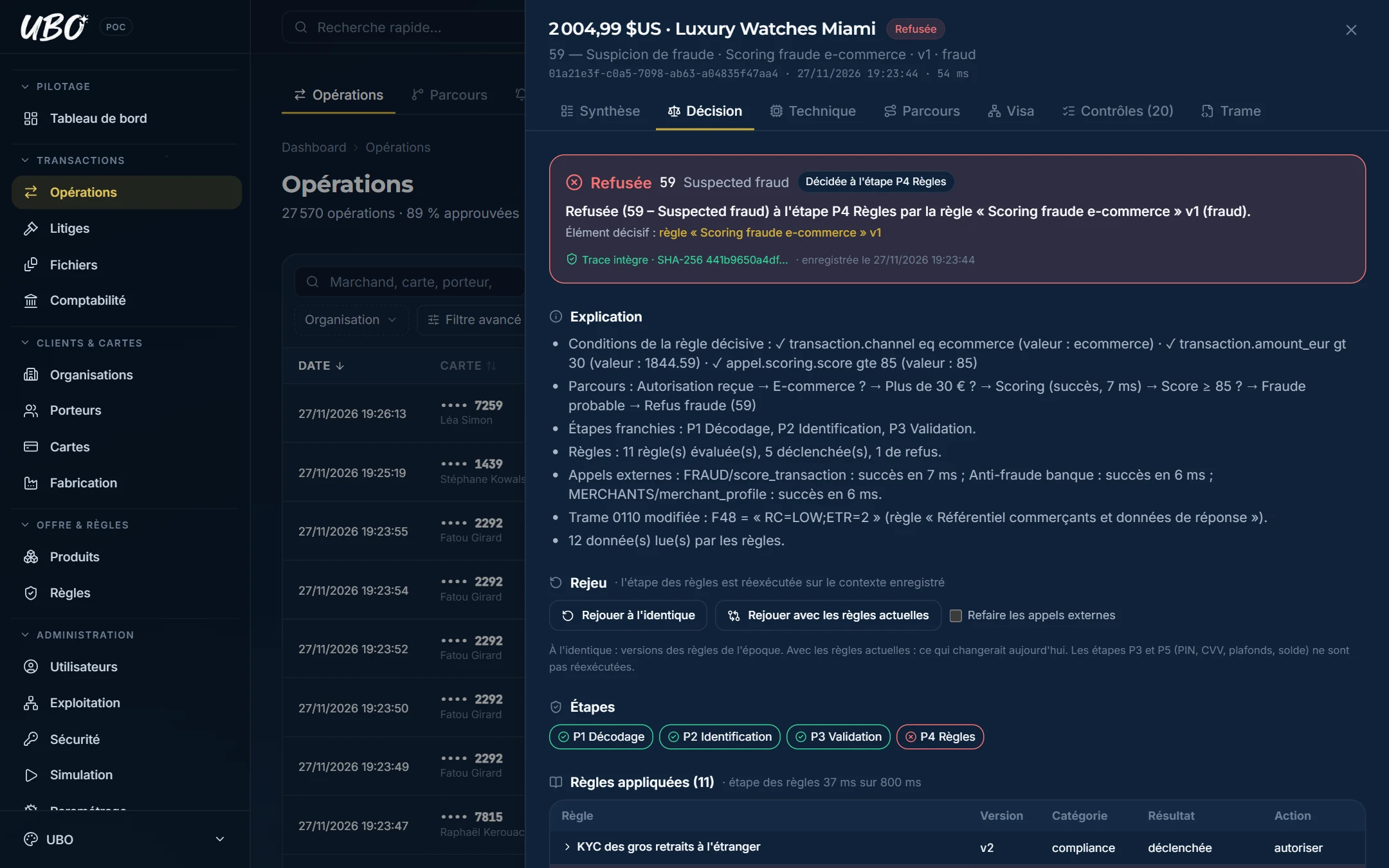
Explained decisions Each decision is recorded: deciding step, rules and versions, data read, calls, sentence of explanation, integrity fingerprint. Replayed as it was or with today’s rules.
3-D Secure Authentication of online payments (ACS), PSD2 exemptions (low value, risk analysis), challenge by code.
Stand-in and offline The authorizations given by the network during an outage, and the chip’s offline operations, are taken back and applied.
Cash-back, incremental authorizations, pre-authorizations Hotels, fuel, rentals: hold, increment, final presentment, expiry.
Alerts Probable fraud, AML: each alert is taken, qualified and closed.
Decision tab of a declined authorization
Why this operation was declined: the deciding rule, its version, its conditions with the values read, and the replay.
Authorization rules
The bank's rules, by category, with their state and scope.
Feature What it does
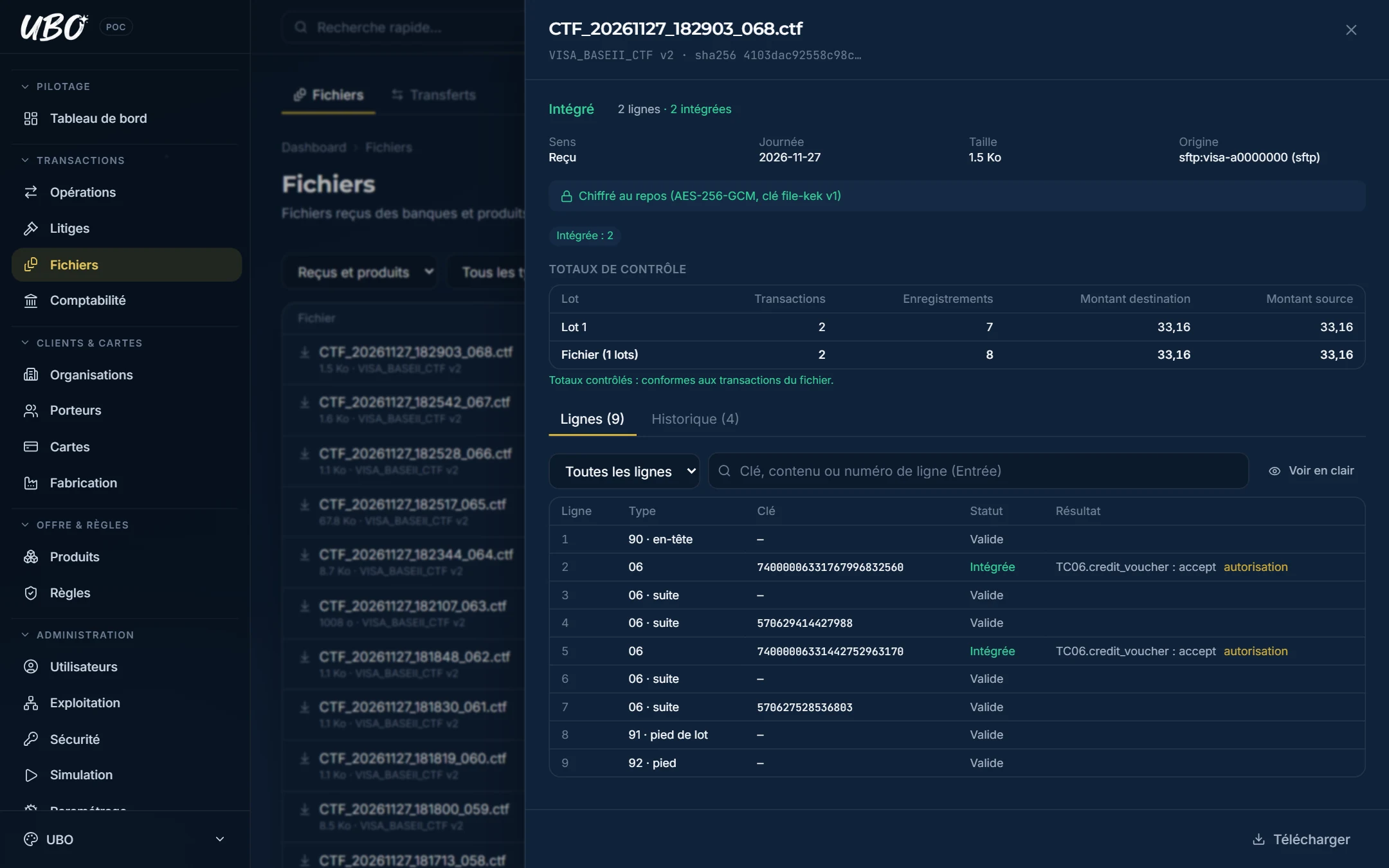
Clearing BASE II files received over SFTP (EBCDIC, PGP-encrypted), checked by their totals, integrated line by line, matched with the authorizations. Duplicate file refused. Orphan presentments flagged.
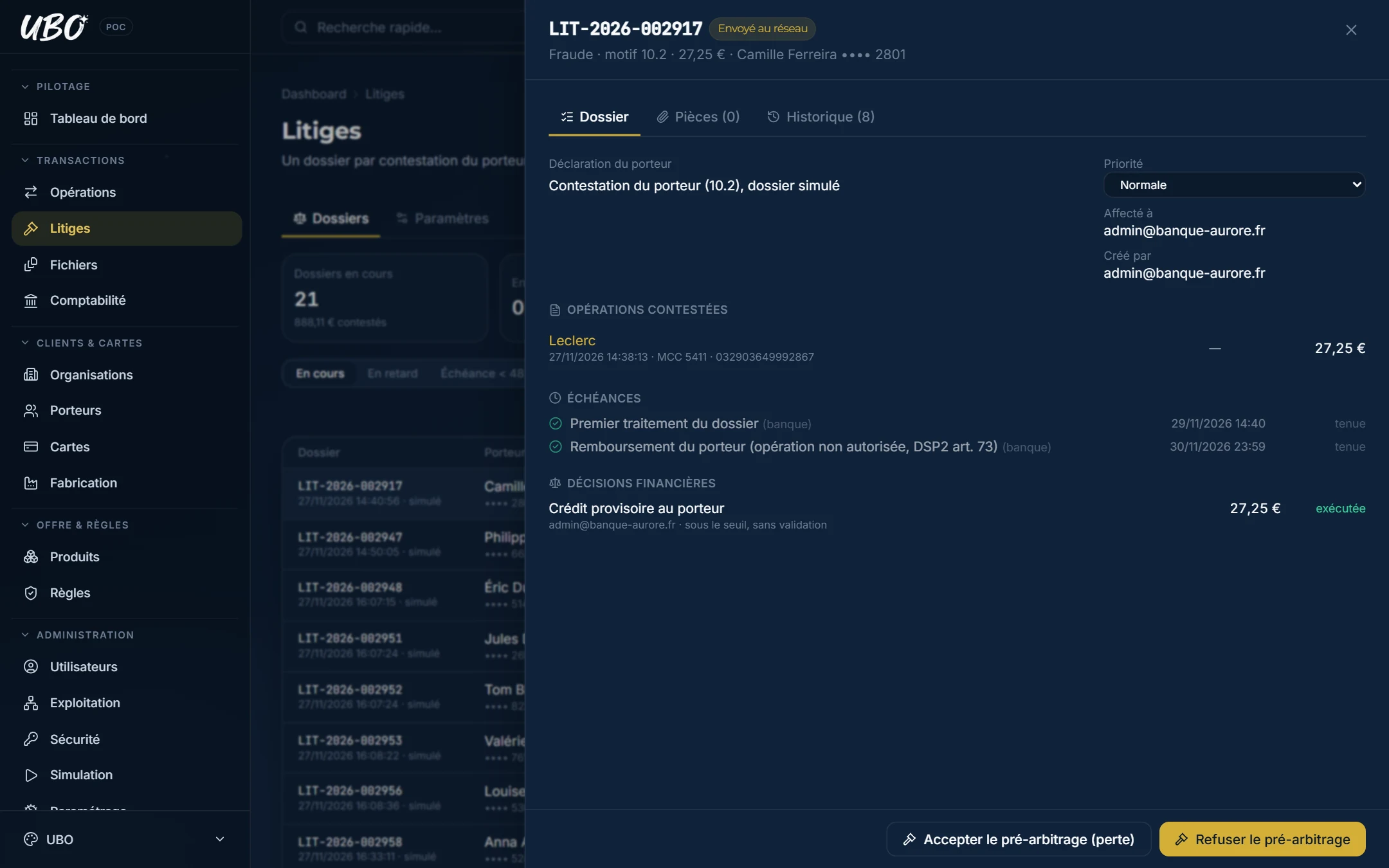
Disputes Cases grouping transactions, encrypted and versioned evidence, network and internal deadlines (PSD2), four-eyes financial decisions, exchanges with the network.
Accounting Double-entry postings at each event, accounting scheme per bank, closed days, daily accounting report, trial balance.
Files and transfers Declarative format engine, immutable files, line-by-line checks, replay; SFTP server for partners, SSH keys, acknowledgements, dead letters and recovery.
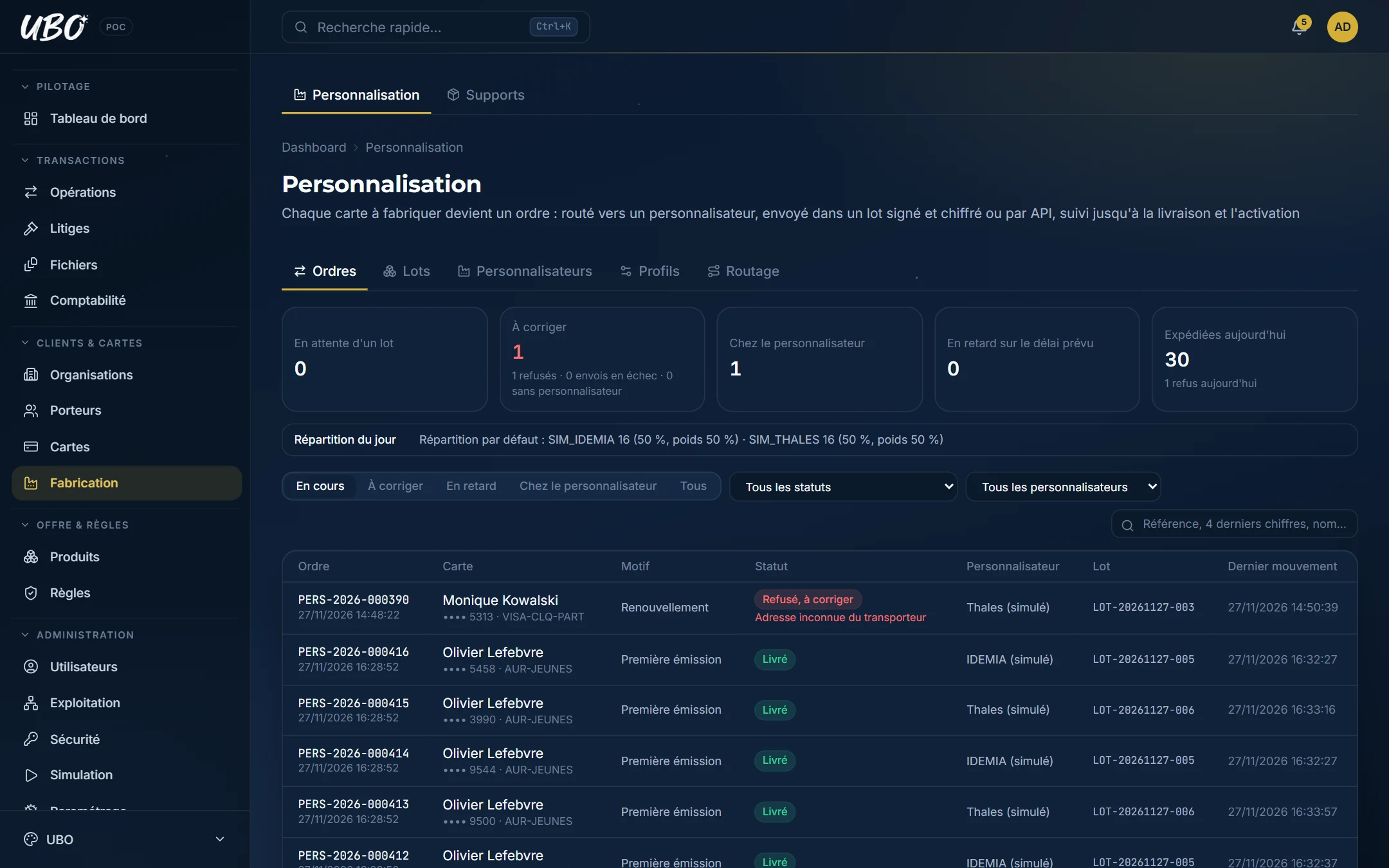
Manufacturing Personalisation orders sent to the personalisers (signed and encrypted file, or API), batches, tracking of each plastic until delivery.

A dispute case
A dispute case: disputed transactions, deadlines, financial decisions.
Feature What it does
Dashboard and reporting Real-time activity, volumes, approval rates, decline reasons, countries, merchants, per day over 30 days and more.
Audit trail Each action, its author, its object and its result; search and export.
Events and webhooks Event catalogue, publication on Kafka (order kept per object), signed webhooks with retries.
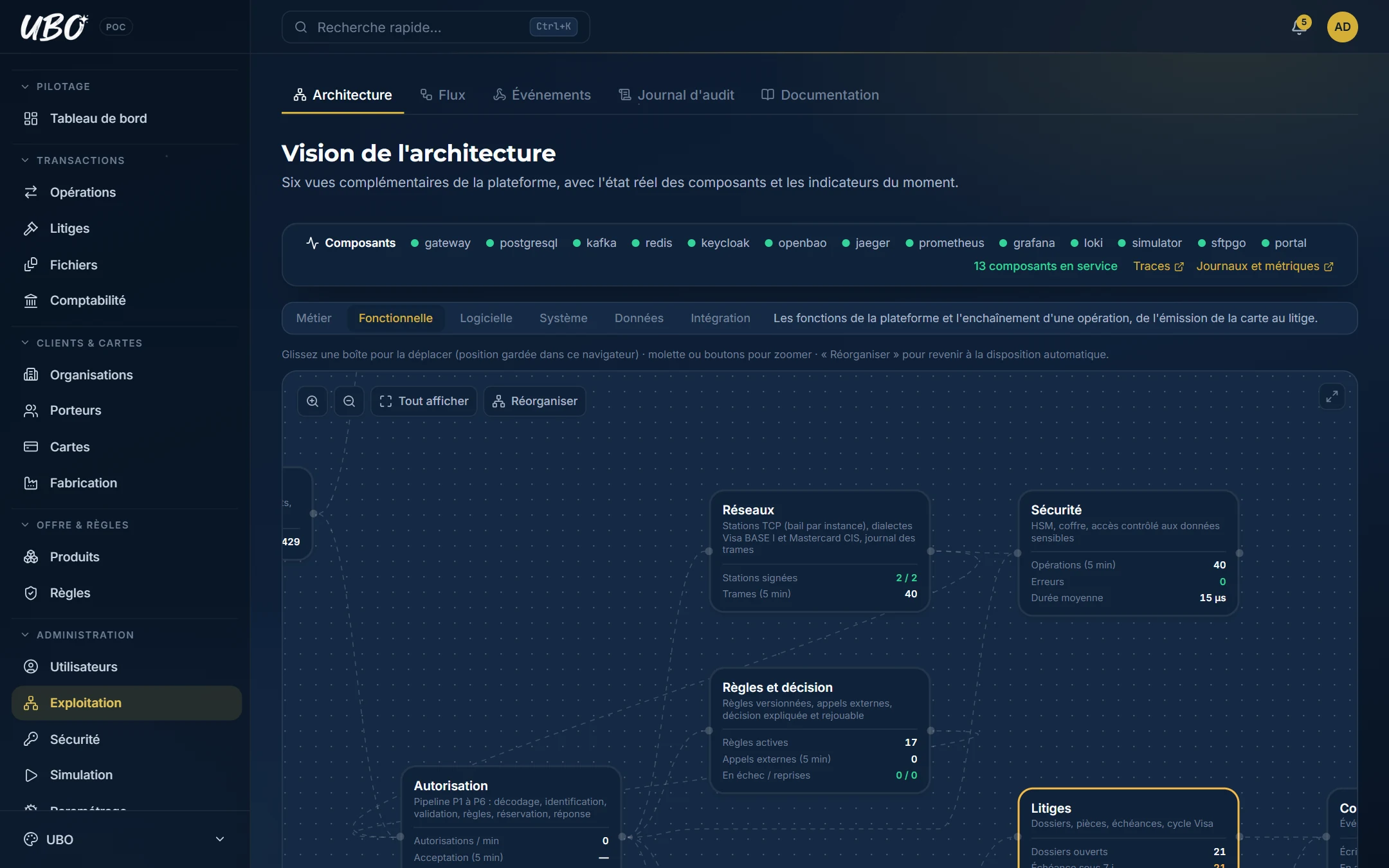
Architecture vision Six views (business, functional, software, system, data, integration) with the real state of the components; flows followed end to end.
Scheduled jobs Scheduler in the database: planning, retries, alerts, history.
Multi-bank Banks isolated by the database, quotas per bank, platform administrator.
White label Portal themes (colours, typography, logo), card designs, domains.
Architecture vision in the portal
The architecture vision: the components and their real state, in the portal.
Feature What it does
HSM Keys of the platform and of the networks (ZMK, ZPK, CVK, IMK), PIN, CVV, EMV cryptograms, signatures; rotation and revocation.
Secrets vault Certificates, API keys, partners’ passwords, with their expiry and rotation.
Access to sensitive data Card number or file content in clear: justified request, four eyes per policy, limited time, log.
Isolation Row-level security in the database: a bank never reads another bank’s data, even through a bug of the code.
Permissions Roles and permissions per area (read, write, admin), scope per organisation.

Coming Advanced permissions (attributes, delegation), configuration versions and product migration, wallets (Apple Pay, Google Pay).